Thursday, April 26, 2012

All In: It’s Culture that Drives Results

In the New York Times, Stephen I. Sadove, chairman and chief executive of Saks Inc., explains that it is culture that drives results:
It starts with leadership at the top, which drives a culture. Culture drives innovation and whatever else you’re trying to drive within a company — innovation, execution, whatever it’s going to be. And that then drives results.

When I talk to Wall Street, people really want to know your results, what are your strategies, what are the issues, what it is that you’re doing to drive your business. They’re focused on the bottom line. Never do you get people asking about the culture, about leadership, about the people in the organization. Yet, it’s the reverse, because it’s the people, the leadership, the culture and the ideas that are ultimately driving the numbers and the results.
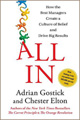
While we know that our most important resource is our people, it’s not so easy to get people “all in”—convincing people to “truly buy into their ideas and the strategy they’ve put forward, to give that extra push that leads to outstanding results.”

All In
All In by Adrian Gostick and Chester Elton explains why some managers are able to get their employees to commit wholeheartedly to their culture and give that extra push that leads to outstanding results and how managers at any level, can build and sustain a profitable, vibrant work-group culture of their own. All In takes the principles found in their previous books—The Orange Revolution and The Carrot Principle—and expands on them and places them in a wider context.

They begin by explaining that it all rests on the “belief factor.” People want to believe, but given the fact that “failure could cost them their future security why shouldn’t they be at least a little dubious about your initiatives?” But belief is key. “As leaders we must first allow people on our teams to feel like valuable individuals, respecting their views and opening up to their ideas and inputs, even while sharing a better way forward. It’s a balancing act that requires some wisdom.”

To have a culture of belief employees must feel not only engaged, but enabled and energized. What’s more, “each element of E+E+E can be held hostage by an imbalance in the other two.”

The authors have created a 7 step guide to develop a culture where people buy-in:

Define your burning platform. “Your ability to identify and define the key “burning” issue you face and separate it from the routine challenges of the day is the first step in galvanizing your employees to believe in you and in your vision and strategy.”

Create a customer focus. “Your organization must evolve into one that not only rewards employees who spot customer trends or problems, but one that finds such challenges invigorating, one that empowers people at all levels to respond with alacrity and creativity.”

Develop agility. “Employees are more insistent than ever that their managers see into the future and do a decent job of addressing the coming challenges and capitalizing on new opportunities.”

Share everything. “When we aren’t sure what’s happening around us, we become distrustful….In a dark work environment, where information is withheld or not communicated properly, employees tend to suspect the worst and rumors take the place of facts. It is openness that drives out the gray and helps employees regain trust in culture.”

Partner with your talent. “Your people have more energy and creativity to give. There are employees now in your organization walking around with brilliant ideas in their pocket. Some will never share them because they don’t have the platform to launch those ideas on their own. Most, however, will never reveal them because they don’t feel like a partner in the organization.”

Root for each other. “Our research shows incontrovertible evidence that employees respond best when they are recognized for things they are good at and for those actions where they had to stretch. It is this reinforcement that makes people want to grow to their full shape and stature.”

Establish clear accountability. “To grow a great culture, you need to cultivate a place where people have to do more than show up and fog a mirror; they have to fulfill promises—not only collectively but individually.” And this has to be a positive idea.

Gostick and Elton explain that the “modern leader provides the why, keeps an ear close to those they serve, is agile and open, treats their people with deference, and creates a place where every step forward is noted and applauded.”

The authors skillfully examine high-performing cultures and present the elements that produce them. A leader at any level can implement these ideas to drive results. A great learning tool.

Quote
To succeed, you need everyone on your team all in; you need a culture of belief. A high performing culture is characterized by people that are engaged, enabled and energized.

http://www.leadershipnow.com/leadingblog/2012/04/all_in_its_culture_that_drives.html

Tuesday, April 3, 2012

An Offer You Can't Refuse: Leadership Lessons From "The Godfather"


What does a real-life CEO have in common with the central figures of a fictitious Mafia crime family in The Godfather? According to Justin Moore, CEO and founder of Axcient, plenty.

Moore is a serial entrepreneur, early-stage advisor, and angel investor. He’s currently at the helm of Axcient, a company he founded that provides backup, business continuity, and disaster recovery services to the small and mid-sized business (SMB) market. Right now, Axcient is protecting more than 2 billion files and applications for businesses across North America.

Moore also happens to think that The Godfather is “one of the best movies ever made” and had a chance to watch it again when the film was aired extensively last week to mark the 40th anniversary of its premiere. Though a decade had passed since the last time Moore watched it, his recent viewing offered an unexpected reward. This time he found the film rife with teaching moments for CEOs running a business today.

“I certainly don’t endorse crime or violence, and I’m not suggesting business should operate like the Mafia,” explains Moore, “but there are some universal themes in the movie I can relate to as a CEO.” Moore says The Godfather offers valuable lessons in community and team building, making tough decisions, and playing to win while not neglecting friends and family.

Here are five essential leadership lessons Moore distilled for Fast Company.

1. Build a powerful community.

Someday, and that day may never come, I'll call upon you to do a service for me. ~Vito Corleone

Uttered in the iconic rasp of Marlon Brando, the words of Vito Corleone illustrate how he creates a loyal community among those he has helped. Moore says, “By granting these favors and helping people with their problems, Vito Corleone is building a network of influence--relationships that may or may not deliver a specific or quantifiable return, but all which serve to strengthen his power base and which have the potential to be reciprocal in the long run.”

Moore says building strategic partnerships enables companies to work through challenging markets and fast-track overall success. “As a CEO, I see it as part of my job to be a super connector, networking with the technology and investment community without an expectation of reciprocation. Partnerships forged through time, trust, and mutual benefit--such as those Axcient has built with HP, Ingram-Micro, and a vast network of service providers and resellers--are the types of community relationships that bring about the greatest returns.”

2. Hold people accountable.

What's the matter with you? I think your brain is going soft. ~Vito Corleone

The Godfather reminds us of the importance of being tough when necessary. “As soon as Vito Corleone allowed a few moments of weakness to be seen by his enemy, they attempted to assassinate him. And it was largely because of failures of his team,” Moore observes.

“In business, accountability isn’t achieved by a murderous rampage. But the lesson is this--to be successful in business you have to be tough, and you have to be extremely focused on hitting goals and getting results," says Moore. That doesn’t mean patience and understanding don’t have a place, he says, but ongoing tolerance of low-performing people or products just eats away at the success of the entire company. “You are ultimately responsible for all of your employees and shareholders, and that requires tough and swift decisions.

3. Don’t get emotional.

It’s not personal, Sonny. It’s strictly business. ~Michael Corleone
“Many people don’t like to talk about the fact that in business, there are winners and losers. When Sonny Corleone reacts impulsively and emotionally, he gets taken out. In business, if you don’t take the opportunity to out-sell, out-bid, or out-market your competitor, they’ll take you out. I’m not suggesting doing anything outside the boundaries of morality or rightness--simply pointing out that when people make emotional decisions, they start making bad decisions. To lead successfully, you have to take your emotion and ego out of the equation."
Likewise, Moore says it’s important to play to win. In business, that translates to knowing the competition and always staying at least one step ahead. “Operate your business with integrity and have respect for competition, but you also need to seize opportunities to eliminate your competition and win.”

4. Be decisive.

Moore says that he, like most people who appreciate The Godfather, watch the movie with a combination of shock and respect. “Shock because he is so ruthless that he kills his own family member, but respect for the fact that Don Corleone knows exactly what he wants, executes decisively, and commands respect through unwavering leadership.”

While you don’t have to kill anyone to prove a point, as soon as you know what choice to make, move forward. “Know who on your team is making the right choices, and trust them to take decisive action as well. Hesitation too often leads to missed opportunities.”

5. Spend time with your family.

Do you spend time with your family? Because a man who doesn’t spend time with his family can never be a real man. ~Vito Corleone
Moore isn’t endorsing 1940s machismo, but he is decrying 100-hour workweeks that many entrepreneurs fall prey to in hot pursuit of the next big thing. Though he’s been dedicated like that in the past, Moore finds it’s not sustainable in the long run.

“A leader can’t be successful in creative problem-solving and making excellent decisions unless that person is connected to people and passions outside of work. I find that it’s often time with family and friends that gives me the perspective I need to build the relationships and make the decisive actions required for continued success in business,” says Moore.

Thanks to Lydia Dishman from Fast Company for this article

Monday, March 26, 2012

Why Top Talent Leaves: Top 10 Reasons Boiled Down to 1

By: Erika Andersen, Forbes Contributor

Eric Jackson, a fellow Forbes blogger I follow and find both funny and astute, wrote a really spot-on post last month about why top talent leaves large corporations. He offered ten reasons, all of which I agreed with – and all of which I’ve seen played out again and again, over the course of 25 years of coaching and consulting. The post was wildly popular – over 1.5 million views at this writing.


So why do we find this topic so interesting? I suspect it’s because we’re genuinely curious: What would make a very senior executive – someone who most certainly has been courted by his or her organization and then paid huge sums of money to join – decide to pack it in? Is it greed (an even richer offer down the street)? Hubris? Short attention span? Or do 1%ers actually leave jobs for the same reasons as the average Joe or Josie?


According to Jackson (and, again, I agree with him) top talent does indeed leave for the same reasons everyone else does. If I were to distill his ‘top ten reasons’ down to one, it’s this:


Top talent leave an organization when they’re badly managed and the organization is confusing and uninspiring.

About half of Eric’s ten reasons are about poor people management – either systemically, as in poor performance feedback, or individually, as in, my boss sucks. And the other half are about organizational lameness: shifting priorities, no vision, close-mindedness.


It really is that simple. Not easy, mind you, but remarkably simple. If you want to keep your best people:

1) Create an organization where those who manage others are hired for their ability to manage well, supported to get even better at managing, and held accountable and rewarded for doing so.

2) Then be clear about what you’re trying to accomplish as an organization – not only in terms of financial goals, but in a more three-dimensional way. What’s your purpose; what do you aspire to bring to the world? What kind of a culture do you want to create in order to do that? What will the organization look, feel and sound like if you’re embodying that mission and culture? How will you measure success? And then, once you’ve clarified your hoped-for future, consistently focus on keeping that vision top of mind and working together to achieve it.

I’ve worked with client organizations that do those two things, and people stay and thrive. I’ve worked with and observed client organizations that don’t – and it’s a revolving door. And that’s true at all levels – not just for “top talent.”

Friday, March 9, 2012

Fire the Wrong People Today

By Eric Markowitz Inc.com

Kevin Ryan has hired--and fired--plenty of people in his day. Here, the Gilt CEO explains why not firing an employee can cause a bad situation to "fester."


"If you have a 100 person company, someone is No. 100," Kevin Ryan told the audience at the Inc. 500

5000 Conference recently. "If you have a 20 person division, someone is No. 20."
Six months ago, Ryan was tasked with hiring a new manager to oversee a division of Gilt. He gave the new manager three objectives, to be completed within the first few months. They were:


-Evaluate the people you have now and lay off the people that don't fit.

-Promote people internally.

-Maintain and retain your best people.

After six months, Ryan knew the manager hadn't built an effective team. Morale was low, and a couple of key employees left the company. Rather than giving the manager more time to solve the problem, Ryan let him go immediately.

"A bad situation will fester," he says. "It is your job as CEO to make sure those situations don't happen. You're ruining the DNA of that company…by letting it go."

Monday, March 5, 2012

Ten Commandments of Business Behaviour

Being efficient and productive aren't the only keys to a successful career.
Keep these rules in mind for a healthy and happy workplace.


1. Thou shalt have a positive attitude.

Everybody has bad days. Nobody has the right to take it out on others. Rudeness, impoliteness, surliness, ugly moods, unprovoked displays of anger, and general unpleasantness can be costly to your career - and your company's bottom line.

2. Thou shalt be on time.

Keeping others waiting is the ultimate power play - whether it's a meeting, an email, a telephone call, or that charmingly Jurassic example of business behaviour, a letter. In the end, it's self-defeating. Everybody's busy. Everybody's time is valuable. Being late only makes you look like you don't have your act together.

3. Thou shalt praise in public and criticize in private.

If you intend to improve a situation or someone's performance, public criticism is the worst approach. It serves no purpose except to humiliate the other person, and possibly lead to cutthroat retaliation. Remember that the office gossip looks far worse than those being gossiped about.

4. Thou shalt get names straight.

We all forget people's names. There is nothing wrong with saying: "Please tell me your name again. My brain just went on strike." But there is something wrong with not checking on correct spelling whenever you write a name. That's lazy. It can cost your career. And remember, it's a big mistake to assume you can call somebody by his or her first name. We have four generations working in a truly global marketplace. Each generation feels differently about using first names.

5. Thou shalt speak slowly and clearly on the telephone.

Texting makes us forget how we sound, or when we speed-talk. Again, remember those four generations in the work arena, as well as the diversity of cultures. A smile can be heard in your voice. So smile or you will sound irritated and put out. Not a good move when business is on the line.

6. Thou shalt not use foul language.

KIND is the only four-letter word for the workplace. Don't accept vulgarity, poor grammar and slang as your personal standards. They are three of the top reasons people don't get hired. On the other hand, liberal use of "please", "thank you", and "excuse me" can be most helpful in one's career ascent.

7. Thou shalt dress appropriately.

Don't enter your workplace without knowing its dress code. If you must, call the human resources department and ask. Good grooming is at least 10 times more important than making a fashion statement. Good taste and fashion are not always synonymous.

8. Thou shalt take clear messages.

It pays to take time to be sure the messages you take are clear, correct and complete.

9. Thou shalt honour social courtesies at business functions.

Etiquette is just a matter of common sense with a large dose of kindness. Make sure you respond to invitations promptly and never bring an uninvited guest without permission. Never be a no-show when you said you'd show. Good guests contribute as much to a party as good hosts.

10. Thou shalt be accountable.

We all make mistakes. That does not give us license to blame someone else for them. There is no shame in admitting you don't have all the answers. Yet there is shame in not being willing to look for them.

Wednesday, February 29, 2012

5 Traits of Highly Successful Salesmen

By Geoffrey James  of INC Magazine

Are you cut out to make the sale? Make sure you've got these characteristics--or else learn to develop them.


Selling and buying are not purely intellectual exercises. Buyers and sellers are emotional human beings, which is why great salespeople are always masters at managing their own emotions. Based upon my observation (and some pretty hefty research in emotional intelligence), highly successful salespeople cultivate the following five emotional traits:

1. Assertiveness

This allows you to move a sales situation forward without offending or frustrating the customer. Think of it as being located halfway between passivity and aggressiveness. For example, suppose a customer is delaying a decision. There are at least three basic responses:

Passive: "Could you give me a call when you've made a decision?"

Aggressive: "If you don't buy right now, the offer is off the table."

Assertive: "Can you give me a specific time and date when you'll make your final decision?"

The passive response puts the sale on hold indefinitely (or give your competitor the opening to outsell you). The aggressive response creates pressure and resentment: Even if it works, you'll be seen as a typical pushy salesman. The assertive approach sets up the specific conditions for the close, without forcing the customer's pace.

2. Self-Awareness

You need to be able to identify your own emotions, understand how they work, and then use them to help you build stronger customer relationships. This is a four-step process:

Identify the emotions that you're feeling,

Based on experience, predict how those emotions will affect your sales effort.

Compensate for negative emotions that might hinder the sale.

Expand your positive emotions that might help you make the sale.

For example, suppose you feel furious that an important customer stood you up. You might take a break before your next meeting in order to remind yourself of all the times you've succeeded in the face of challenges. Or you might, as an ice-breaker, tell your second customer that you're having a tough day and why.

3. Empathy

This entails adapting your behavior to the customer's moods and emotions. It begins with listening and observing, but simply knowing what the customer might be feeling is not enough. You must be able to feel what the customer is likely to be feeling.

Suppose, during a sales call, you discover that the customer's firm just announced major layoffs. You could ignore the news and proceed with the sales call as if nothing had changed, or you could focus on your own desire to make the sale and ask your contact who will have buying authority after the layoffs are over.

Both responses to the event make business sense–but if you want to build a better relationship, you'll be empathetic and imagine your contact's sense of fear and confusion. Then, depending on your emotional reading of the customer, decide whether the customer would prefer to commiserate, complain or (alternatively) be distracted from the situation.

4. Problem Solving

The desire to solve a problem helps you create new ways to satisfy the customer's needs, both financial (the ROI of your offering) and emotional–such as the customer's need to be convinced that your and your firm are reputable and reliable. Problem solving is a four step process:

See the customer situation as it really is. (Never try to solve a problem before you fully understand it.)

Help the customer visualize a more desirable situation.

Devise a way to move the customer from the ways things are today to the way the customer would like them to be.

Communicate that solution in a way that makes it easy for the customer to make a decision.

While those steps might seem obvious, they're the exact opposite of old-school salesmanship, where selling entails "giving a great sales pitch."

5. Optimism

Optimism helps you maintain a sense of balance when things go awry. It proceeds directly from the (often unspoken) rules that you use to interpret daily events. For example, if the first sales call of the day goes poorly, your performance for the rest of the day will be different if you have this rule...

A bad first call means that I'm off my game this will be a bad day.
... rather than this rule:

Every sales call is different, so the next will probably be better.
Note that both rules are arbitrary responses to the same event, and neither is more "realistic" than the other. Even so, if you automatically jump to the first rule, rather than the second, it will be difficult for you to remain happy.

This principle works on bigger events, too. I've run into about a dozen top salespeople who saw the weak economy as an opportunity to sell even more,and did so, while their colleagues were busy hand-wringing.

Wednesday, February 22, 2012

The 5 Hardest Jobs to Fill in 2012

By Keith Cline  INC Magazine

While you're planning your expansion, you're going to find that talent is in short supply, especially in these five areas.


The year flew by mostly because it was a very, very busy one.
Although the economy continues to face many challenges, the startup and tech industries are very much alive. The IPO window slightly opened up for companies like LinkedIn, Pandora, Groupon, Zynga, and Carbonite. We saw monster rounds of funding for companies like Facebook, Twitter, Dropbox. The appetite for seed and angel investing was extremely active. Tech incubators and accelerator programs kept popping up.
It was also a very busy year for hiring at startup companies, as you know, and it doesn't look like that will slow down in 2012. We've certainly seen opinions on both sides of the fence as to whether or not there is a tech bubble or 2012 will be another active year of investing. I'm an optimist and I believe the pace of investing will remain consistent. Yes, some companies will fail, of course, but others will scale and grow their teams at a steady clip.

Hiring the best of the best is an absolute must if you are going to build a successful company. You will need to be prepared to compete against big companies with deep pockets and other up-and-coming startups that also have blue chip investors and a game-changing idea.

So, what are the most competitive areas for talent these days? Here's a look:

Software Engineers and Web Developers

The demand for top-tier engineering talent sharply outweighs the supply in almost every market especially in San Francisco, New York, and Boston. This is a major, major pain point and problem that almost every company is facing, regardless of the technology "stack" their engineers are working on.

Creative Design and User Experience

After engineers, the biggest challenge for companies is finding high-quality creative design and user-experience talent. Since almost every company is trying to create a highly compelling user experience that keeps people engaged with their product, it is tough to find people who have this type of experience (especially with mobile devices including tablets) and a demonstrated track record of success.

Product Management

It is always helpful for an early-stage company to hire someone who has very relevant and specific experience in your industry. This is especially true for product management, since the person in this role will interface with customers and define the product strategy and use cases. However, be prepared, as it will be a challenge to find people with experience in these high-growth industries: consumer web, e-commerce, mobile, software as a service, and cloud computing.

Marketing

I'm not talking about old-school marketing communications. Companies are looking for expert online marketers who know how to create a buzz of inbound marketing or viral traffic through the web, social media, and content discovery. Writing a good press release just doesn't cut it anymore, as everyone is looking for the savvy online marketing professional who understands how the current state of the web operates and knows how to make it work to their benefit.

Analytics

Since data is becoming more and more accessible, smart companies are increasingly making decisions driven by metrics. Analytics is becoming a central hub across companies where everything (web, marketing, sales, operations) is being measured and each decision is supported by data. Thus, we are seeing a high level of demand for analytics and business intelligence professionals who almost act like internal consultants; they help determine what should be measured and then build out the capability for a company.